
In 1943, Saudi Arabia didn't send the British king a plaque
A diamond-set sabre, a rationed capital, and what an object can say that a letter cannot.
Buckingham Palace had been hit several times during the Blitz and parts of it were still patched up three years later. Blackout curtains, taped glass, the King and Queen on the same ration books as everybody else. Britain in the winter of 1943 was a country living on credit and nerve, and it looked it.
That November, two young men from a kingdom eleven years old arrived to see the King. Prince Faisal and Prince Khalid, sons of Abdulaziz, there on their father's behalf.
They brought him a sword.
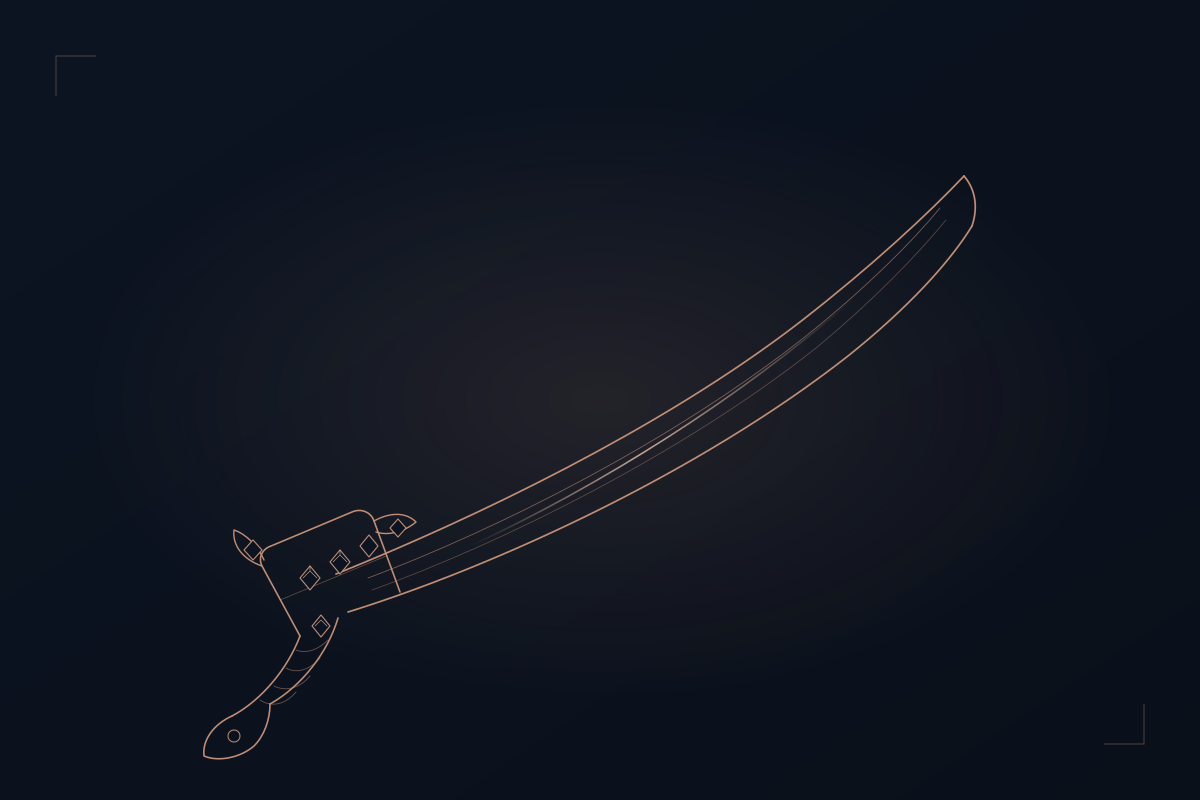
Not a presentation sword in the European sense. A shamshir, curved, the Arabian form, which is already a decision worth noticing. Gold fittings. Diamonds. The arms of Saudi Arabia. And worked into it in diamonds, a Tree of Life.
The Tree of Life is not filler ornament. It is one of the oldest motifs in the region, and what it carries is continuity, a line that goes back further than anyone can account for and is not going to stop. A state founded in 1932 chose to send that particular symbol, in diamonds, to an empire that had been running things for three centuries. I have thought about that choice a lot and I still find it extraordinary.

The timing was not accidental either. On 3 October, six weeks earlier, the Treaty of Jeddah had been renewed, the agreement in which Britain recognised the Saudi state and its independence. Renewing a treaty in the middle of a world war is two governments telling each other, in public, that they intend to keep going.
But the sword is only interesting once you know what had happened ten years before that.
In 1933 Abdulaziz put the oil concession for his Eastern Province out to bid. The British were in the room. So were the Americans. He gave it to the Americans.
By 1943 that decision was starting to show its shape. Washington had begun treating Saudi Arabia as something close to a strategic necessity, American money and American engineers were arriving in the east, and Britain was too busy staying alive to do much about it. Nobody in that palace drawing room was going to raise any of this. You do not say that sort of thing out loud.
So the object said it instead.
There is no deference in that sword. It is not a client thanking a patron. It is gold and diamonds carried into a rationed capital by a delegation from a kingdom that had barely finished being founded, at the precise moment that kingdom was becoming the most consequential piece of ground on earth. What it communicates, if you read it plainly, is that we are not here to ask you for anything, we are your equals, please do not forget it.
And the thing about an object is that it does not go away. A letter gets filed. A speech gets walked back by whoever is in office next. That sword went into the Royal Collection and it is still there, saying the same thing it said in 1943, to everyone who has looked at it since.
Did it change the outcome? Almost certainly not. Britain's position in Arabia was already going and one sword was never going to hold it. But that was never really what it was for. Gifts at that level do something narrower and more immediate. They make it very hard for the other party to treat you as small. You cannot receive something like that and then be condescending to the man who sent it. The register of the conversation has already been set before anyone sits down.
There is a footnote to this that I like even more than the sword.

Fifteen months later, in February 1945, Abdulaziz met Churchill in person at Fayyum in Egypt, a few days after meeting Roosevelt aboard an American warship. He arrived the way he always arrived. Jewelled swords, robes, pearls, gold, gifts for the entire British party down to the staff.
Churchill had brought perfume.
By the accounts of that meeting he realised within about a minute how badly he had been outdone, and told the King that the perfumes were only a token and that something proper was on its way. He then went off and arranged to have the finest motor car in the world sent to Riyadh.
Winston Churchill. Years into leading Britain through the war, at the absolute height of his standing in the world. And he felt the need to go back and fix a gift.
I have spent twenty five years in rooms where things change hands between serious people, and the pattern has never once varied. The ones who get this right are almost never the ones spending the most. They are the ones who understand that a gift is a sentence, and that it is going to be read whether they meant it to be or not.
Abdulaziz got it right because the sword worked in three directions at the same time. It suited the man receiving it, a king in a rationed capital who needed to be met as a king. It suited the man sending it, a founder establishing where his kingdom stood. And it suited the moment, six weeks after a treaty and ten years after an oil decision, in the last winter before the whole map changed.
Hardly anybody does this now.
Now it is the engraved crystal. The plaque. The pen set with a logo on it. Chosen in an afternoon from a catalogue by somebody who was not in the meeting and does not know what the meeting was about. It gets photographed once, it goes in a drawer, and the sentence it writes is that we did not spend very long thinking about you.
Some relationships are worth an object. Not many. But the ones that are, are worth getting right, and most people never even ask themselves which is which.
What did Saudi Arabia give King George VI in 1943?
A shamshir, the curved Arabian sabre, with gold fittings, diamonds, the arms of Saudi Arabia and a Tree of Life motif set in diamonds. It entered the Royal Collection, where it remains.
Who presented it, and when?
Prince Faisal and Prince Khalid, two of King Abdulaziz's sons, presented it on their father's behalf at Buckingham Palace in November 1943. Both later became kings of Saudi Arabia.
Why was it significant?
It arrived six weeks after the Treaty of Jeddah was renewed on 3 October 1943, the agreement in which Britain recognised Saudi independence, and ten years after King Abdulaziz awarded the Eastern Province oil concession to American rather than British interests. The sabre asserted parity between an eleven-year-old kingdom and an empire, at exactly the moment American influence in Arabia was overtaking British influence.
What is a shamshir?
A curved, single-edged sabre of Persian and Arabian form. Choosing a shamshir rather than a straight European presentation sword was itself a statement of cultural authorship by the giver.
What makes a ceremonial gift appropriate today?
The same three things it needed in 1943. It has to suit the person receiving it, express the person or institution giving it, and match the moment it is presented in. Objects that satisfy only one of the three read as generic, however much they cost. This is the standard we work to on every commission.
A continuing series on gifts that changed the register of a room.